

Who we are
Sacha Ñampi Ecolodge features eight private eco-friendly cabins with a capacity for 20 guests. Its infrastructure includes a restaurant, relaxation area, kitchen, a hut for spiritual events, a reception area, and wooden walkways connecting all the cabins. The entire hotel infrastructure is designed to blend seamlessly with nature. Located within the Kichwa community of Alta Florencia, the lodge holds an operating permit issued by the Ecuadorian Ministry of Tourism and the Ministry of the Environment.
The lodge is managed by the community itself. It is important to note that the lodge is located within Yasuní National Park, in the Aguarico Canton, Orellana Province, Ecuador.
Sacha Ñampi began operations in 2008 thanks to the efforts of the Aguarico Canton Tourism Network.
The lodge’s main activities are centered around the flora, fauna, culture, and gastronomy of the Kichwa people.

Location
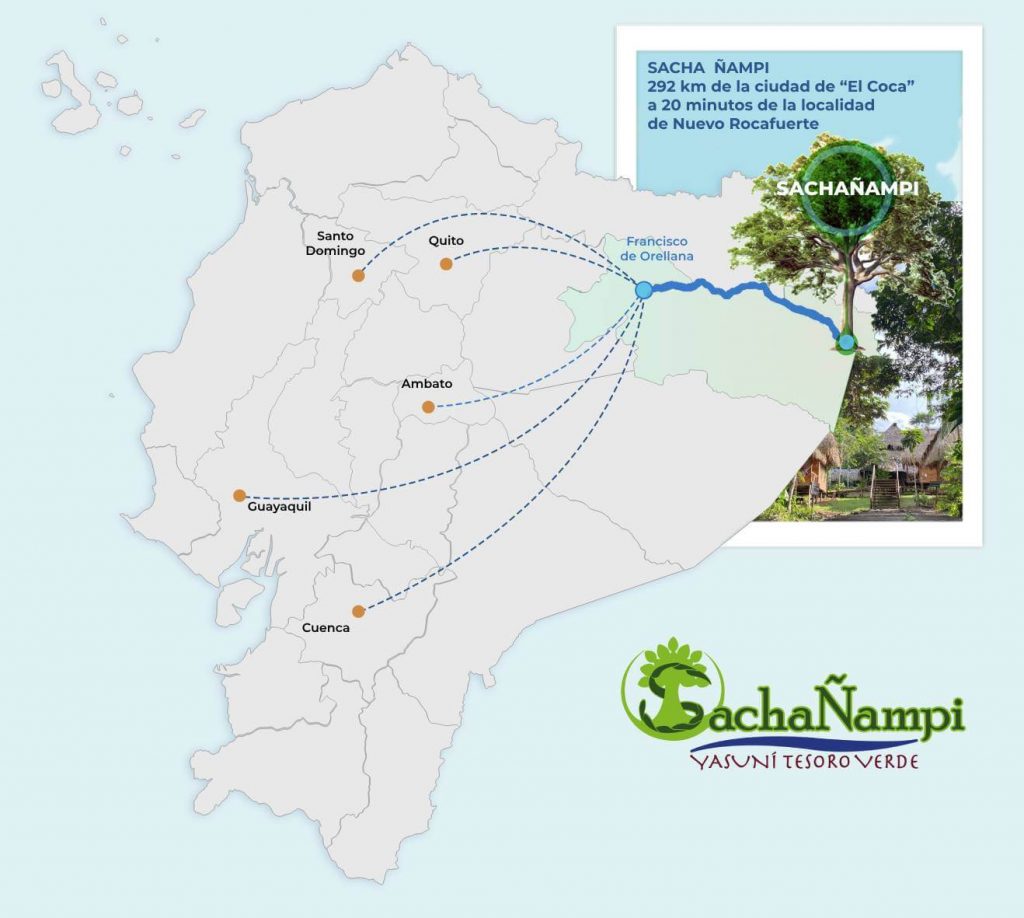
Sacha Ñampi is located on the banks of the Napo River, in the Kichwa community of Alta Florencia, Nuevo Rocafuerte parish, Aguarico canton, Orellana Province, Ecuador. It is 292 km from the city of El Coca and 15 minutes from the town of Nuevo Rocafuerte.
PAYMENT METHODS FOR TOUR PACKAGE PURCHASES
- We Travel reserves with 10%.
- Interbank transfer from abroad “18% fee applies”
- Balance payable in cash upon arrival in Coca
How to get to Sacha Ñampi Ecolodge from Quito?
By Air
Quito – Coca – Quito.
- Time 35 minutes
By land
Quito – Coca – Quito.
- Distance – 286 km
- Time 8 hours by public transport
- Time 5 hours by private car
River transport
Coca – Sacha Ñampi – Coca
- Distance – 292 km.
- Travel time: 4:00
- Departure times: 8:00 a.m. – 1:00 p.m.
- Return times: 6:00 a.m. – 12:00 p.m.
Kichwa commune Alta Florencia biography & its community projects
Kichwa community Alta Florencia is located in Nuevo Rocafuerte Parish, Aguarico Canton, Orellana Province. It was created in 1997. Currently, its population is 140 inhabitants and its global territory is 5.333 hectares, bordering Yasuní National Park, it has a great tourist potential which is organized by the community tourism center “Sacha Ñampi”; created freely and voluntarily by 25 partners who commit to encourage sustainable and responsible tourism, with the program called Socio Bosque conservación de flora y fauna committed to work on this tourist initiative with the construction of a rustic tourist hotel that at the same time lends all tourist services and activities.
This is a high endemism and faunist production area, with a great tourist potential which must be linked to a sense of conservation and protection of nature. The conservation of biodiversity in areas characterized by great tourist attraction is a challenge that all regions of the world and especially fragile ecosystems and areas adjacent to protected natural areas. Implementation of good practices related to environmental and social management protects the integrity of ecosystems and local cultures; increases the viability of tourism enterprises by providing financial stability, quality jobs and encouraging the development of local communities. Communities can enjoy healthy environments by conserving ecosystems and natural and cultural resources for these and future generations.
Yasuní National Park – Green treasure
“LUNG OF THE WORLD”
FLORA The number and variety of vegetables are greater than in any other terrestrial ecosystem of the world. Yasuni forests house the largest number of tree species per hectare in the world, which means, even greater fauna diversity.
HERPETOFAUNA The herpetofauna here is one of the largest worldwide, more than 100 amphibian species have been registered, with 43 tree frog species and a hundred other reptiles, including 62 snake species.
Sacha Ñampi means “Path to the Forest” in Spanish.
It is a community tourism project created by the Kichwa community of Alta Florencia, with registration and operating permit No. 2202500274 granted by the Ministry of Tourism of Ecuador, suitable for tourism operations within its communal territory and Yasuni National Park, this project It includes the conservation and protection of the Kichwa culture, flora and fauna through the “Socio Bosque” project, vigilantes of approximately 5000 hectares of the 1022736 that it houses the Yasuni National Park. It is important to emphasize the importance of this park since it represents for the equator and the whole world as a Biosphere Reserve declared by UNESCO and contains the largest extension of tropical forest in Ecuador, being one of the largest oxygen-free generators that share with the whole world, Yasuni “Lung of the World”.
Inside the park
Inside the park live the Huaorani indigenous nationality and some uncontacted groups such as Tagaeri and Taromenane. For all this it is considered one of the most emblematic Parks in the country and the world.


``Socio Bosque`` flora and fauna conservation project
Kichwa Alta Florencia commune in 2015 by agreement with the Ministry of the Environment of Ecuador signs an agreement of 20 years with the objective of conserving flora and fauna of its own territory and a large part of Yasuni National Park, that, through an economic incentive, the community is responsible for monitoring and protecting the flora and fauna, around 2,000 hectares, where Sacha Ñampi performs the tourist operation of flora and fauna and through the visit of foreign and national tourists collaborate with the economic incentives to continue protecting the mother nature of Yasuni.
